Common Documentation Questions When Buying Process Enzymes
For a pharmaceutical API manufacturer, an enzyme is not only a catalyst selection. It is a supply, quality, impurity, and validation decision that must fit the intended route and the internal control strategy.
When process chemists evaluate a bulk enzyme supplier for pharmaceutical biocatalysis, the technical conversation usually moves quickly from conversion performance to documentation readiness. The right package should help your team assess route fit, define incoming controls, support impurity risk assessment, and avoid late-stage supply surprises.
Below are common documentation questions to ask before moving from screening material to kilo, pilot, or commercial purchasing.
1. What identity and composition information is available?
At minimum, buyers should understand what is being supplied, how it is presented, and whether the form is suitable for the intended process environment.
Typical questions include:
- What is the enzyme class and intended catalytic function?
- Is the material supplied as liquid, powder, immobilized preparation, or another format?
- What stabilizers, carriers, salts, preservatives, or formulation components are present?
- Are there any components that may affect downstream isolation, crystallization, filtration, or impurity profiles?
- Is the supplied form appropriate for aqueous, solvent-tolerant, slurry, or immobilized-process use?
For API work, the documentation should be clear enough for process development, analytical, quality, and regulatory stakeholders to align on how the enzyme enters the route and how it will be controlled.
2. What quality documents are normally requested?
Process enzyme purchases often require a practical document set rather than a generic product brochure. Depending on phase and internal procedures, API manufacturers may request:
- Technical data sheet
- Safety data sheet
- Certificate of analysis or lot release summary
- Specification or typical quality attributes
- Country of origin statement
- Manufacturing site information where appropriate
- Allergen, animal-origin, or BSE/TSE statement where relevant
- GMO or recombinant production statement where relevant
- Storage and handling guidance
- Shelf-life or retest guidance
- Packaging and transport information
The exact package depends on how the enzyme is used, the clinical or commercial phase, and whether the enzyme is considered a process reagent, processing aid, immobilized catalyst, or upstream raw material within your quality system.
3. Can the supplier support lot traceability?
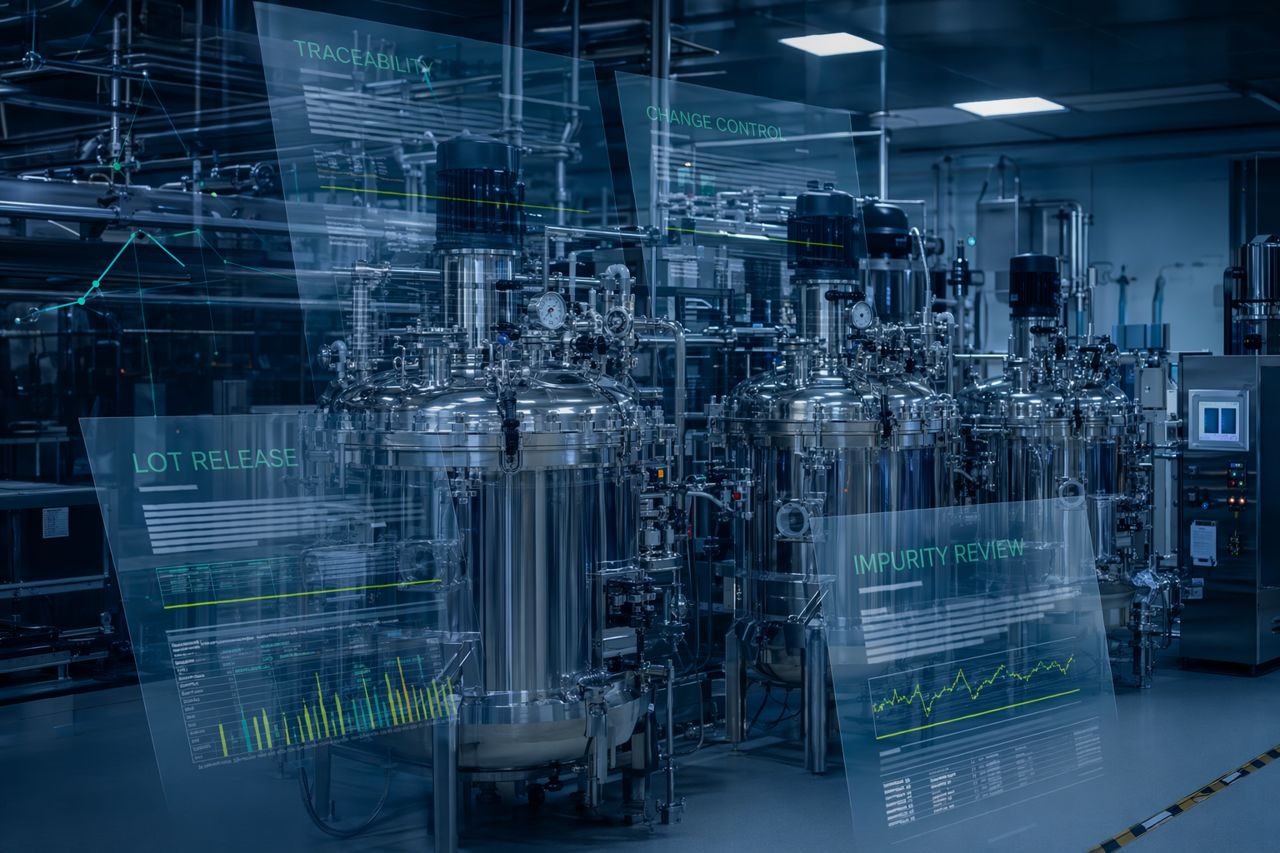
Traceability matters when a biocatalytic step becomes part of a locked route. Buyers should confirm whether the supplier can provide batch or lot identifiers, release records, retained documentation, and shipment traceability.
Ask how lot records are maintained, whether repeat supply can be linked to defined production batches, and how documentation is delivered with each shipment. For larger API programs, it is also useful to understand whether reserved lots, campaign planning, or forward inventory can be discussed before scale-up.
Traceability does not need to be overcomplicated, but it must be reliable enough for deviation review, change assessment, and internal audit expectations.
4. What change-control information is available?
A process enzyme can be sensitive to changes in production strain, downstream processing, formulation, carrier system, preservative package, immobilization chemistry, packaging, or manufacturing site.
Before qualification, ask:
- What types of changes are notified to customers?
- How much advance notice is typical for material or process changes?
- Are formulation or site changes communicated before shipment?
- Can the supplier support comparison material for internal bridging studies?
- How are discontinued grades or replacement materials handled?
Change control is especially important when the enzyme affects impurity fate, residual protein clearance, stereochemical outcome, or robustness of a critical process step.
5. How should impurity and clearance questions be framed?
Most API teams need documentation that supports a risk-based impurity discussion. The supplier may not own your full route or downstream controls, but they should help you understand the enzyme material well enough to design appropriate checks.
Useful topics include:
- Known formulation components and their relevance to the process
- Potential residual protein considerations
- Inorganic salts, preservatives, carriers, or immobilization support materials
- Microbial-origin or fermentation-derived material considerations
- Downstream removal expectations based on process design
- Suitability of the enzyme format for your isolation strategy
The key is to connect supplier documentation with your own analytical control strategy. Do not wait until late development to ask whether the enzyme format could influence extraction, carbon treatment, crystallization, filtration, or residual impurity assessment.
6. Is the enzyme manufactured under GMP?
This question needs careful language. Many process enzymes used in API manufacturing are not themselves GMP APIs. They may be used upstream as process reagents or processing aids, with suitability justified through supplier qualification, incoming controls, route clearance, and impurity risk assessment.
Ask what quality system applies to manufacture, what release controls are used, and whether the supplier can support documentation appropriate to your phase. If your internal procedures require specific quality agreements, audit questionnaires, or vendor qualification documents, raise those needs early.
A practical supplier will avoid unsupported claims and help define what can be documented, what can be controlled, and what remains the responsibility of the API manufacturer.
7. What scale-up and supply documents should be discussed early?
A screening vial and a commercial supply plan are different purchasing events. Before committing to a route, confirm that supply can scale with your program.
Discuss:
- Available pack sizes for development, pilot, and production
- Lead times for repeat supply
- Minimum order quantities for bulk purchase
- Campaign or reserved-batch options
- Packaging compatibility with your site handling procedures
- Cold-chain or controlled-temperature needs
- Import documentation and logistics constraints
- Expected shelf life during campaign planning
For API manufacturers, supply confidence is part of route confidence. A biocatalytic step is only attractive if the catalyst can be delivered with predictable quality, documentation, and timing.
8. What should be requested before a quote?
A quote request is more useful when the supplier understands the process context. You do not need to disclose confidential route details at the first contact, but a structured technical brief helps avoid mismatched recommendations.
Helpful information includes:
- Enzyme class or reaction type of interest
- Substrate family or non-confidential model substrate
- Desired product stereochemistry or selectivity goal
- Approximate development phase
- Required enzyme format, if known
- Expected purchase scale or campaign size
- Solvent, pH, temperature, or process constraints at a high level
- Documentation requirements from quality or procurement
- Target shipping region and timeline
This allows Chiralift to respond with a route-relevant supply option and the documentation path needed for internal review.
Documentation checklist for API enzyme purchasing
Use this short checklist when comparing suppliers:
- Product identity and formulation are clearly described
- Safety and technical documents are available
- Lot-specific quality documentation can be supplied
- Traceability is maintained from production to shipment
- Change-control expectations are stated before qualification
- Origin, recombinant, animal-origin, or allergen statements are available where relevant
- Storage, shelf-life, packaging, and logistics are defined
- Impurity and clearance discussions can be supported technically
- Scale-up supply, lead time, and bulk packaging are realistic
- Supplier communication is precise, documented, and responsive
Chiralift perspective
Chiralift supplies bulk enzymes for pharmaceutical biocatalysis with a focus on route fit, documentation clarity, impurity-aware discussions, and scale-up support. The goal is not to oversell a catalyst. The goal is to help process chemistry and quality teams decide whether an enzyme can be qualified, controlled, and supplied for the intended API route.
If you are evaluating a process enzyme for development, pilot, or production use, share your non-confidential process requirements and documentation needs.
Request a quote for bulk enzyme supply and documentation support.