Process Chemistry Vocabulary Procurement Teams Should Know Before Buying Enzymes
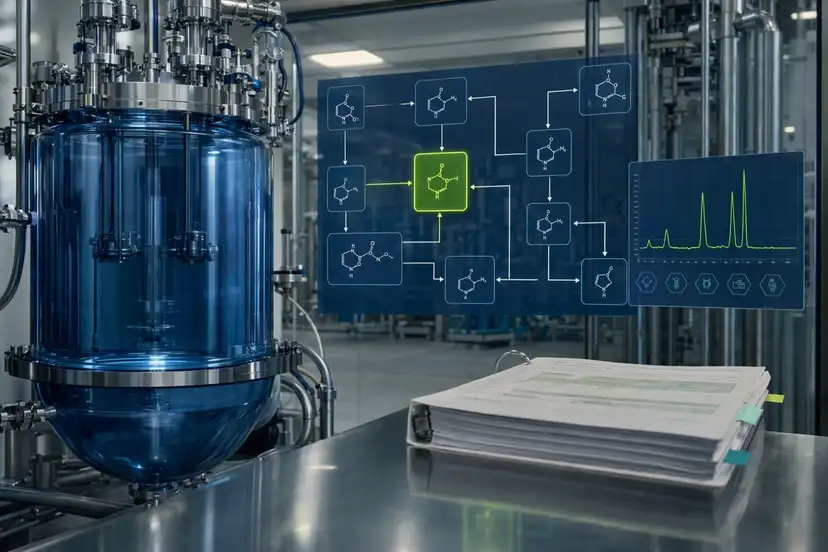
Buying enzymes for an API route is not the same as buying a general process aid. In pharmaceutical biocatalysis, the enzyme can affect route economics, impurity strategy, validation burden, lead time, and scale-up risk. Procurement teams do not need to speak like process chemists, but they do need enough vocabulary to ask the right commercial and technical questions before a supplier is approved.
Chiralift supports API manufacturers sourcing enzymes for chiral synthesis, selective transformations, intermediate production, and route optimization. This guide defines the process chemistry terms that commonly appear during enzyme sourcing, technical review, and RFQ alignment.
Why vocabulary matters in enzyme procurement
A low purchase price is rarely the lowest-cost option if the enzyme creates downstream burden. Procurement should understand whether the enzyme supports:
- Route fit within the intended process sequence
- Reliable impurity control and stereochemical outcome
- Practical handling at pilot and commercial scale
- Batch-to-batch consistency for validated manufacturing
- Documentation required for supplier qualification
- Supply security for campaign and lifecycle demand
For a pharmaceutical API manufacturer, the most useful supplier conversation connects process performance, documentation, and supply continuity before the first purchase order.
Core terms procurement teams should know
Biocatalysis
Biocatalysis uses enzymes to perform chemical transformations under process-relevant conditions. In API manufacturing, it is often used to introduce chirality, resolve stereoisomers, improve selectivity, reduce harsh reagents, or simplify purification.
Procurement relevance: Ask whether the enzyme is positioned for research screening, process development, pilot supply, or commercial manufacturing. A supplier that only supports early discovery may not be suitable for validated API production.
Chiral intermediate
A chiral intermediate is a non-final compound with defined stereochemistry used in the route toward an API. Enzymes are frequently selected because they can favor one enantiomer or diastereomer with high selectivity.
Procurement relevance: Clarify whether the enzyme purchase is tied to a specific stereochemical target. Incorrect or inconsistent selectivity can increase rework, purification load, and regulatory risk.
Route fit
Route fit describes how well an enzyme-enabled step integrates with the overall synthetic route, including solvent system, substrate form, downstream isolation, impurity profile, equipment, and campaign timing.
Procurement relevance: A lower-cost enzyme may be unsuitable if it requires process changes that increase total cost. Request supplier feedback on route context, not only catalog description.
Transformation step
The transformation step is the specific chemical conversion performed by the enzyme. Examples include reduction, transamination, hydrolysis, acylation, oxidation, and resolution.
Procurement relevance: Define the transformation clearly in the RFQ. Procurement should avoid vague requests such as “enzyme for chiral step” and instead include the substrate class, desired product class, and process stage.
Selectivity
Selectivity describes the enzyme’s preference for the desired product, position, or stereochemical outcome. In API routes, selectivity has direct impact on impurity burden and isolation efficiency.
Procurement relevance: Strong selectivity can reduce downstream separation pressure. Ask how the supplier supports enzyme selection for the required selectivity profile.
Conversion
Conversion refers to how much starting material is transformed into product during the enzyme step. For procurement, conversion should be viewed in context with impurity profile, isolation strategy, and process time.
Procurement relevance: Higher conversion is not automatically better if it creates problematic byproducts. Request technical discussion around usable process outcome, not isolated performance claims.
Impurity profile
The impurity profile is the set of known and potential impurities associated with a process step. For enzyme-enabled API routes, impurities may come from incomplete conversion, side reactions, substrate impurities, enzyme preparation components, or degradation products.
Procurement relevance: Supplier documentation and process familiarity matter. Ask what information can be provided to support impurity risk assessment, quality review, and change control.
Enantiomeric purity
Enantiomeric purity describes how much of the desired mirror-image form is present relative to the undesired form. It is often a key quality attribute in chiral API manufacturing.
Procurement relevance: Procurement should confirm that the enzyme supplier understands the stereochemical requirement and can support consistent supply aligned with the validated route.
Diastereoselectivity
Diastereoselectivity describes the preference for one diastereomer over another when multiple stereochemical centers are involved.
Procurement relevance: If the route contains more than one stereocenter, procurement should ensure the supplier is evaluating the correct selectivity requirement. Misalignment here can lead to significant development delay.
Substrate scope
Substrate scope describes the range of molecules an enzyme can act on. A broad substrate scope can be useful in screening, while a narrower but well-characterized enzyme may be preferred for commercial manufacture.
Procurement relevance: Ask whether the supplier can recommend enzyme candidates based on substrate class and route objective. For late-stage procurement, proven fit is more important than a broad claim.
Process window
The process window is the practical range of conditions under which the enzyme step performs reliably. It can include temperature range, pH range, solvent tolerance, substrate concentration tolerance, and compatibility with process components.
Procurement relevance: A robust process window reduces scale-up risk. Ask whether the enzyme has been used under conditions similar to the planned manufacturing route.
Solvent tolerance
Solvent tolerance describes how well an enzyme performs or remains stable in the presence of organic solvents or solvent mixtures.
Procurement relevance: Solvent compatibility can determine whether the enzyme step fits existing plant infrastructure and downstream isolation. Share intended solvent constraints during RFQ preparation.
Stability
Stability refers to how well the enzyme maintains performance during storage, handling, and processing. It can be affected by formulation, moisture, temperature exposure, and process conditions.
Procurement relevance: Stability affects inventory planning, shipping qualification, campaign readiness, and deviation risk. Ask for storage guidance, shelf-life information, and handling recommendations.
Formulation
Formulation is the physical and chemical presentation of the enzyme, such as powder, liquid, granulated material, or immobilized format. Formulation affects handling, storage, charging, dispersion, and compatibility with the process.
Procurement relevance: The cheapest formulation may not be the safest or most practical for plant use. Confirm whether the proposed format fits facility handling standards and batch charging procedures.
Immobilized enzyme
An immobilized enzyme is attached to a support material. Immobilization can improve handling, separation, reuse potential, or process integration in some routes.
Procurement relevance: Ask whether immobilization adds value for the specific process. It may help in some manufacturing models but add cost or qualification complexity in others.
Loading
Loading describes how much enzyme is used relative to the process requirement. In commercial API manufacturing, loading affects cost of goods, impurity risk, process time, and downstream burden.
Procurement relevance: Compare suppliers using total process impact, not enzyme price alone. A higher-priced enzyme may reduce total cost if it enables lower loading, cleaner conversion, or easier isolation.
Turnover
Turnover describes how efficiently an enzyme can perform repeated catalytic events before performance becomes limiting.
Procurement relevance: Turnover influences process economics. Procurement should ask suppliers to discuss expected performance in the intended process context rather than relying on generic claims.
Scale-up
Scale-up is the transition from small development batches to pilot, clinical, or commercial manufacturing. Enzymatic steps can behave differently at larger scale due to mixing, heat transfer, substrate addition, oxygen exposure, foam, or hold time.
Procurement relevance: Select suppliers that can support scale-up questions, not only ship material. Ask about experience with pilot and production campaign planning.
Tech transfer
Tech transfer is the movement of process knowledge from development to manufacturing or from one site to another. For enzyme steps, it may include handling instructions, process sensitivities, storage controls, and documentation.
Procurement relevance: A supplier that understands tech transfer can help reduce implementation friction. Procurement should request documentation early enough for quality and manufacturing review.
Change control
Change control is the system used to evaluate and approve changes that may affect process performance, quality, or regulatory commitments. For enzyme supply, changes may involve manufacturing site, raw materials, formulation, specifications, or packaging.
Procurement relevance: Ask how the supplier communicates significant changes. For validated API routes, uncontrolled supplier changes can create compliance and production risk.
Lot consistency
Lot consistency refers to reliable performance and quality attributes across supplied batches.
Procurement relevance: Consistency supports validated manufacturing and reduces incoming quality burden. Ask what release documentation and retained quality information are available.
Certificate of analysis
A certificate of analysis is a lot-specific quality document that reports release information for the supplied enzyme.
Procurement relevance: Confirm that the supplier can provide appropriate lot documentation for quality review, incoming inspection, and batch record support.
Specification
A specification defines agreed quality attributes and acceptance criteria for supplied material. For enzymes, specifications should be aligned with intended use and quality expectations.
Procurement relevance: Do not assume a research-grade specification is suitable for API manufacturing. Align specification expectations before commercial supply discussions.
Regulatory support package
A regulatory support package may include supplier statements, origin information, manufacturing information, quality documentation, allergen or animal-origin statements where relevant, residual information, and change notification commitments.
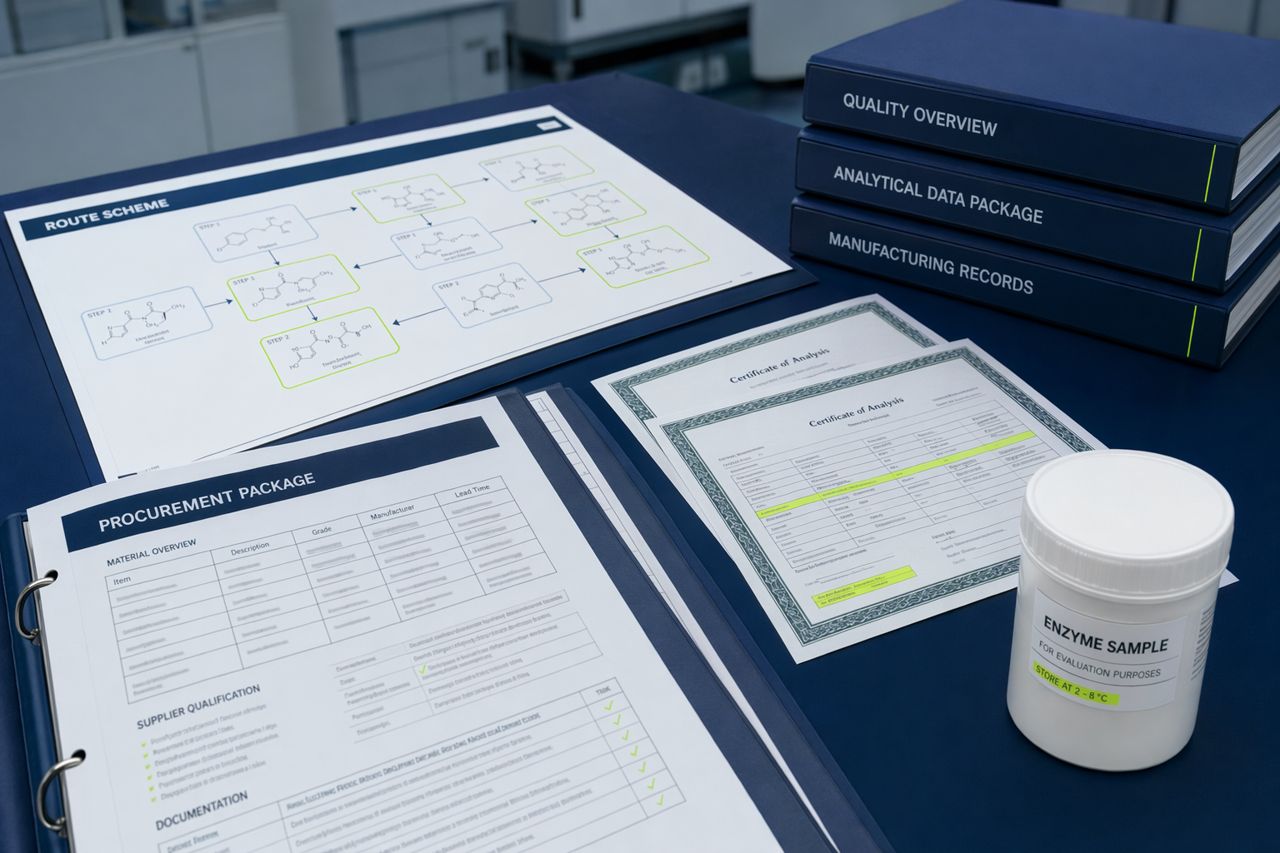
Procurement relevance: Documentation gaps can delay supplier qualification. Ask what documentation is available before nominating a supplier for a validated route.
Supply continuity
Supply continuity is the supplier’s ability to provide material reliably across development, validation, launch, and lifecycle demand.
Procurement relevance: Evaluate lead time, campaign planning, safety stock options, alternate site strategy, and long-term supply alignment. Enzyme procurement should be planned like a route-critical raw material.
RFQ checklist for enzyme procurement in API manufacturing
Before requesting a quote, collect the following information where available:
- Target transformation and route stage
- Substrate and product class, with stereochemical requirement
- Intended manufacturing scale category: development, pilot, validation, or commercial
- Desired enzyme format and handling constraints
- Solvent, pH, temperature, and process compatibility requirements
- Known impurity concerns or purification constraints
- Documentation required for supplier qualification
- Expected annual or campaign demand
- Required lead time and delivery location
- Change control and notification expectations
The more route context procurement can provide, the more useful the supplier response will be.
Common procurement mistakes to avoid
Treating enzyme price as the main decision point
The lowest enzyme price can still create higher total cost if it increases process time, impurity burden, waste, or validation complexity.
Waiting too long to request documentation
Documentation should be reviewed before supplier selection hardens. Late documentation gaps can delay qualification or force route rework.
Separating technical and commercial review
Enzyme sourcing decisions should include process chemistry, quality, manufacturing, and procurement. Each function sees a different risk.
Assuming research material can become commercial supply
A screening enzyme may not have the supply model, documentation, or change control needed for API manufacturing.
Ignoring lifecycle demand
A route may begin with small clinical campaigns and later require larger, recurring supply. Procurement should ask whether the supplier can support the full product lifecycle.
How Chiralift supports enzyme sourcing for API routes
Chiralift supplies bulk enzymes for pharmaceutical biocatalysis with attention to route fit, impurity strategy, documentation, and scale-up readiness. Our team supports procurement and technical groups by aligning the enzyme recommendation with the manufacturing context rather than treating the enzyme as a generic input.
We can help evaluate:
- Enzyme candidates for chiral and selective transformations
- Supply format and handling requirements
- Documentation needs for supplier qualification
- Scale-up considerations for pilot and commercial campaigns
- Lead time, batch planning, and continuity of supply
Request a quote
If you are sourcing an enzyme for an API intermediate or validated biocatalytic step, use the on-site request a quote form. Include the transformation type, route stage, documentation expectations, and estimated demand so Chiralift can respond with a technically aligned supply proposal.