Procurement Handoff Template for Process-Development Raw Materials | Chiralift

A validation-aware handoff template for process chemists transferring enzyme and raw-material requirements from API process development to procurement.

Request pricing

A Procurement Handoff Template for Process-Development Raw Materials

Process-development raw materials are often specified under time pressure: the route is still moving, impurity control is under review, and procurement needs a purchasable specification before the chemistry team has finalized every parameter.

For enzyme-enabled API routes, the handoff needs more than a material name and target delivery date. Procurement must understand what is fixed, what is still under evaluation, and what documentation is required before material enters kilo-lab, pilot, or commercial-readiness work.

Chiralift supports API teams as a bulk enzyme supplier for pharmaceutical biocatalysis. This template is designed to reduce ambiguous sourcing requests, prevent avoidable requalification work, and help procurement engage suppliers with the right technical context from the first conversation.

Why the handoff matters

A weak procurement handoff can create practical issues:

  • A research-grade material is ordered when a development-grade or manufacturing-supported material is needed.
  • Lot documentation arrives too late for QA or analytical review.
  • Storage and shipping constraints are missed, affecting material condition on receipt.
  • A supplier cannot confirm scale-up continuity, forcing late-stage re-sourcing.
  • Procurement compares price without understanding route impact, impurity risk, or supply reliability.

For biocatalytic steps, the enzyme is part of the process design. The handoff should make that clear without overloading procurement with lab detail.

The handoff template

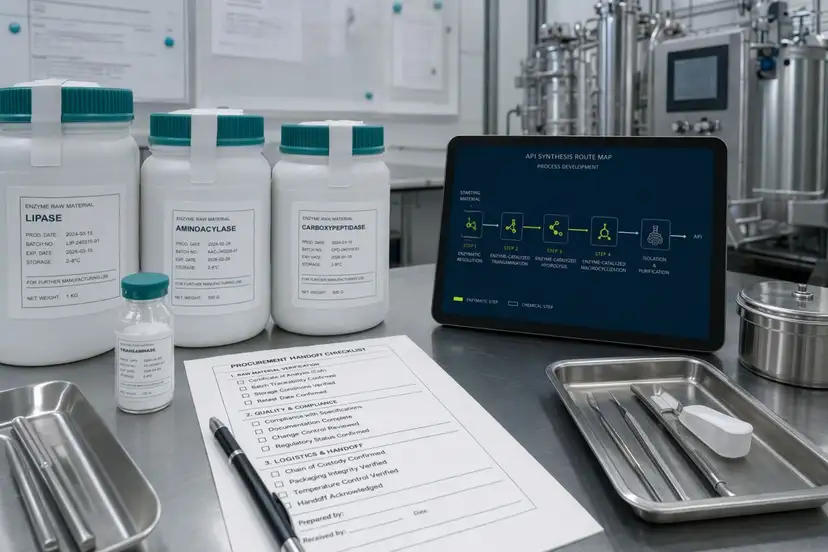
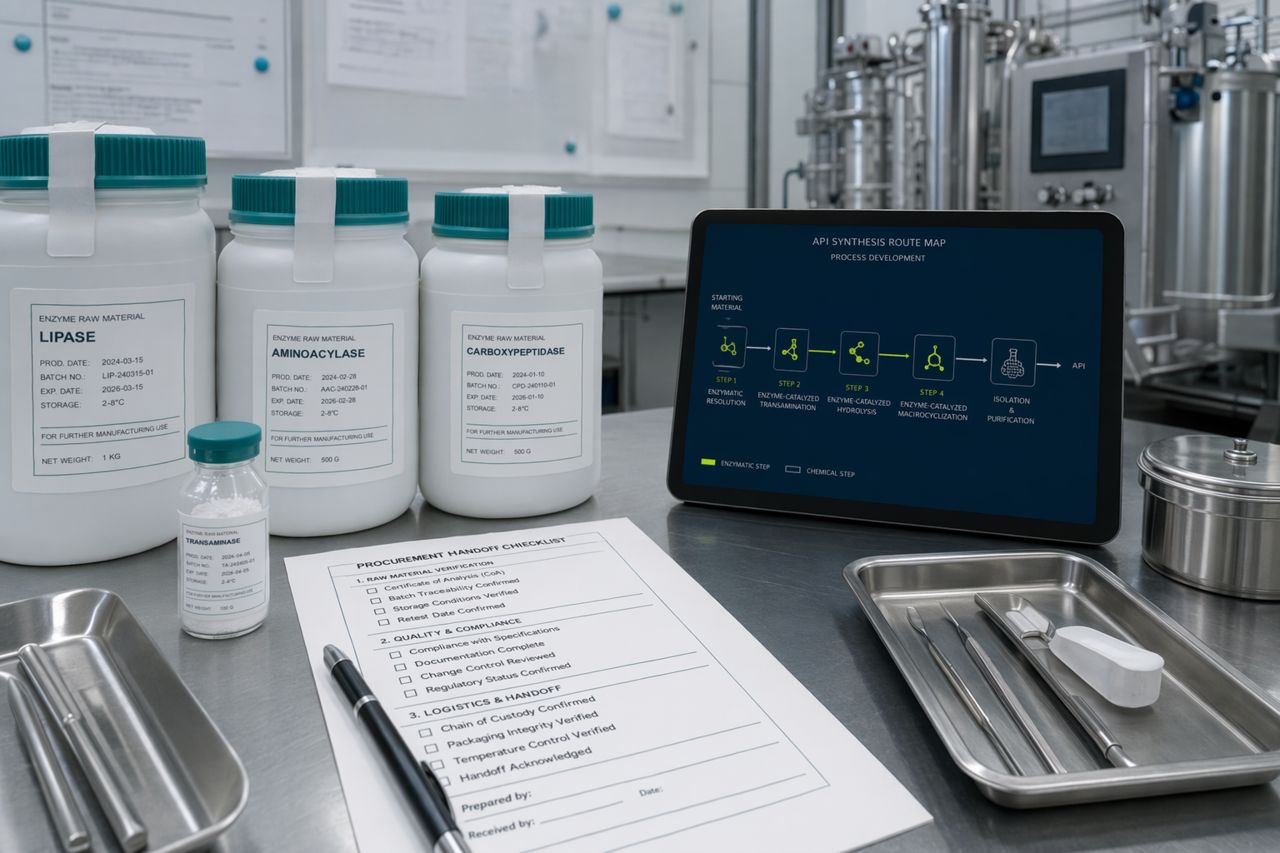
Use the structure below when transferring a process-development raw-material request to procurement. It can be used for soluble enzymes, immobilized enzyme formats, and supporting raw materials used in enzymatic API transformations.

1. Material identity

Provide the basic identity in a format procurement can quote accurately.

  • Internal material name
  • Enzyme class or transformation type
  • Target reaction step or route stage
  • Preferred format: liquid, powder, immobilized, or to be evaluated
  • Known grade requirement, if defined
  • Prior supplier or reference lot, if applicable
  • Any prohibited sources, regions, carriers, or additives

Decision status: fixed / preferred / under evaluation

2. Intended use in the route

Procurement does not need the full route package, but it should understand where the material fits.

  • API intermediate or starting-material step
  • Chiral center formation, resolution, selective hydrolysis, oxidation-reduction, transamination, or other transformation
  • Expected development phase: screening, route confirmation, kilo-lab, pilot, PPQ preparation, or commercial support
  • Whether the material is route-critical or replaceable
  • Whether supplier changes could affect impurity profile, yield, filtration, isolation, or downstream purification

This section helps procurement avoid treating a process-defining enzyme as a commodity input.

3. Technical selection criteria

State the practical requirements that determine route fit.

  • Substrate and product family, with confidentiality controls as needed
  • Operating window for pH, temperature, solvent exposure, and reaction time
  • Tolerance to process-relevant impurities or residual reagents
  • Desired selectivity outcome
  • Compatibility with existing reactor, filtration, and isolation strategy
  • Need for enzyme reuse, immobilized format, or simplified removal
  • Expected development quantity and scale-up direction

Avoid unnecessary method detail. Focus on what the supplier must satisfy to support the process.

4. Documentation requirements

Specify the documentation expected with the quote or before shipment.

  • Certificate of analysis for the supplied lot
  • Safety data sheet
  • Product specification or technical data sheet
  • Material origin and manufacturing-site information, where available
  • Storage, shipping, and handling instructions
  • Recommended retest or shelf-life information
  • Allergen, animal-origin, or biological-source statements if required by internal policy
  • Change-notification expectations
  • Packaging description and container closure information
  • Regulatory support statement for pharmaceutical process use, if available

Flag which documents are required for supplier approval versus which are required before material release to the lab.

5. Quality and supplier expectations

Procurement should know the minimum supplier controls needed for the development stage.

  • Lot traceability
  • Consistent manufacturing route or controlled change process
  • Ability to reserve or reproduce development lots where practical
  • Defined release criteria
  • Deviation communication process
  • Technical contact availability for process-development questions
  • Commercial-scale supply capability or a credible scale-up path

For early development, not every commercial document may be available. The key is to document the gap and decide whether it is acceptable for the current phase.

6. Quantity and scale assumptions

State near-term and future needs separately.

  • Immediate sample or development quantity
  • Anticipated kilo-lab quantity
  • Pilot-scale planning estimate
  • Potential commercial annual demand range, if known
  • Timing of next route decision
  • Whether material should be sourced as a single lot or multiple lots for comparability work

This helps suppliers quote realistic lead times and packaging options.

7. Logistics and storage constraints

Enzyme materials can be sensitive to shipping and storage conditions. Define practical requirements early.

  • Required shipment temperature range
  • Acceptable transit duration
  • Receiving-site storage condition
  • Need for temperature monitoring
  • Packaging size preference
  • Import or customs constraints
  • Hazmat or non-hazmat status as documented by supplier
  • Site-specific receiving limitations

If a route campaign is date-critical, request confirmed dispatch windows rather than estimated availability alone.

8. Commercial comparison fields

Price should be evaluated with supply and process impact in view.

  • Quoted quantity and package size
  • Lead time
  • Minimum order quantity
  • Lot availability
  • Documentation included
  • Technical support included
  • Change-notification terms
  • Scale-up pricing basis
  • Supply continuity statement
  • Payment and delivery terms

For enzymes in API development, the lowest unit price may not be the lowest process risk.

Suggested handoff format

Copy the following into your internal request form or sourcing brief.

Project / route code:
Request owner:
Procurement contact:
Target decision date:

Material name:
Transformation / enzyme class:
Route step:
Development phase:
Decision status: fixed / preferred / under evaluation

Required format:
Required documents:
Required shipment condition:
Required receipt date:
Immediate quantity:
Next scale estimate:

Critical route requirements:
- Selectivity requirement:
- Operating window:
- Solvent / impurity tolerance:
- Removal or reuse requirement:
- Downstream sensitivity:

Supplier requirements:
- Lot traceability:
- Change notification:
- Technical support:
- Scale-up capability:
- Documentation gaps acceptable at this phase:

Commercial comparison notes:
- Lead time:
- MOQ:
- Packaging:
- Supply continuity:
- Quote validity:

Red flags to resolve before ordering

Resolve these points before procurement places the order:

  • The requested material is not linked to a defined route step.
  • The supplier cannot provide lot-specific documentation.
  • The quoted format differs from the format used in development testing.
  • Storage conditions are unclear or incompatible with site receiving.
  • The supplier cannot discuss scale-up beyond sample supply.
  • The material has no defined change-notification pathway.
  • The route team has not stated whether supplier substitution is acceptable.

How Chiralift supports the handoff

Chiralift works with process chemists and procurement teams to align enzyme material supply with API development requirements. We can support:

  • Bulk enzyme sourcing for biocatalytic route steps
  • Format discussions for soluble and immobilized enzyme options
  • Development-to-scale supply planning
  • Documentation review for procurement and quality stakeholders
  • Lot continuity and change-control discussions
  • Technical coordination during route fit and scale-up evaluation

We do not treat enzyme supply as a catalog transaction when the material is tied to an API route decision. The objective is controlled procurement: the right material, the right documentation, and a supply path that fits the next development milestone.

Request a quote

If you are preparing a procurement handoff for a biocatalytic API step, send the route context, target quantity, required format, documentation needs, and timeline through the on-site form.
Request a quote

Procurement Handoff Template for Process-Development Raw Materials | ChiraliftProcurement Handoff Template for Process-Development Raw Materials | ChiraliftProcurement Handoff Template for Process-Development Raw Materials | Chiralift

More from Chiralift

Request pricing & specs

Tell us your application and volume — we reply with pricing and lead time.