Pharma Process Enzyme Sourcing Checklist | Chiralift
A validation-aware checklist for API manufacturers sourcing bulk enzymes for pharmaceutical biocatalysis, from route fit and impurity control to documentation and scale-up support.
Request pricing A validation-aware checklist for API manufacturers sourcing bulk enzymes for pharmaceutical biocatalysis, from route fit and impurity control to documentation and scale-up support.
Request pricingWhen an enzyme becomes part of an API route, the sourcing decision affects more than price and lead time. It influences stereochemical outcome, impurity strategy, batch consistency, documentation readiness, and the ability to move from development to campaign manufacture without avoidable rework.
Chiralift supports pharmaceutical API manufacturers sourcing enzymes for biocatalytic steps where route fit, impurity control, supply confidence, and validation-aware documentation are central to qualification.
Use this checklist to evaluate a bulk enzyme supplier for pharmaceutical biocatalysis before locking the route.
A promising biocatalyst is not automatically a manufacturing-ready fit. The sourcing conversation should start with the route conditions your process team intends to preserve.
A route-fit review reduces the risk of late-stage enzyme replacement, impurity surprises, and process changes that can affect validation timelines.
For API manufacture, enzyme selection should be connected to the impurity control strategy. The supplier should understand that conversion performance, selectivity, and side-product behavior must be evaluated in the context of the route.
Impurity-aware sourcing helps process chemists avoid enzymes that look suitable in early screening but create avoidable analytical, purification, or filing burden later.
Bulk enzyme sourcing for pharmaceutical biocatalysis should be assessed before the process reaches campaign demand. A supplier should be able to discuss supply reliability in operational terms, not vague availability claims.
Supply confidence protects route continuity, purchasing forecasts, and manufacturing schedules when an enzyme becomes a critical raw material for an API step.
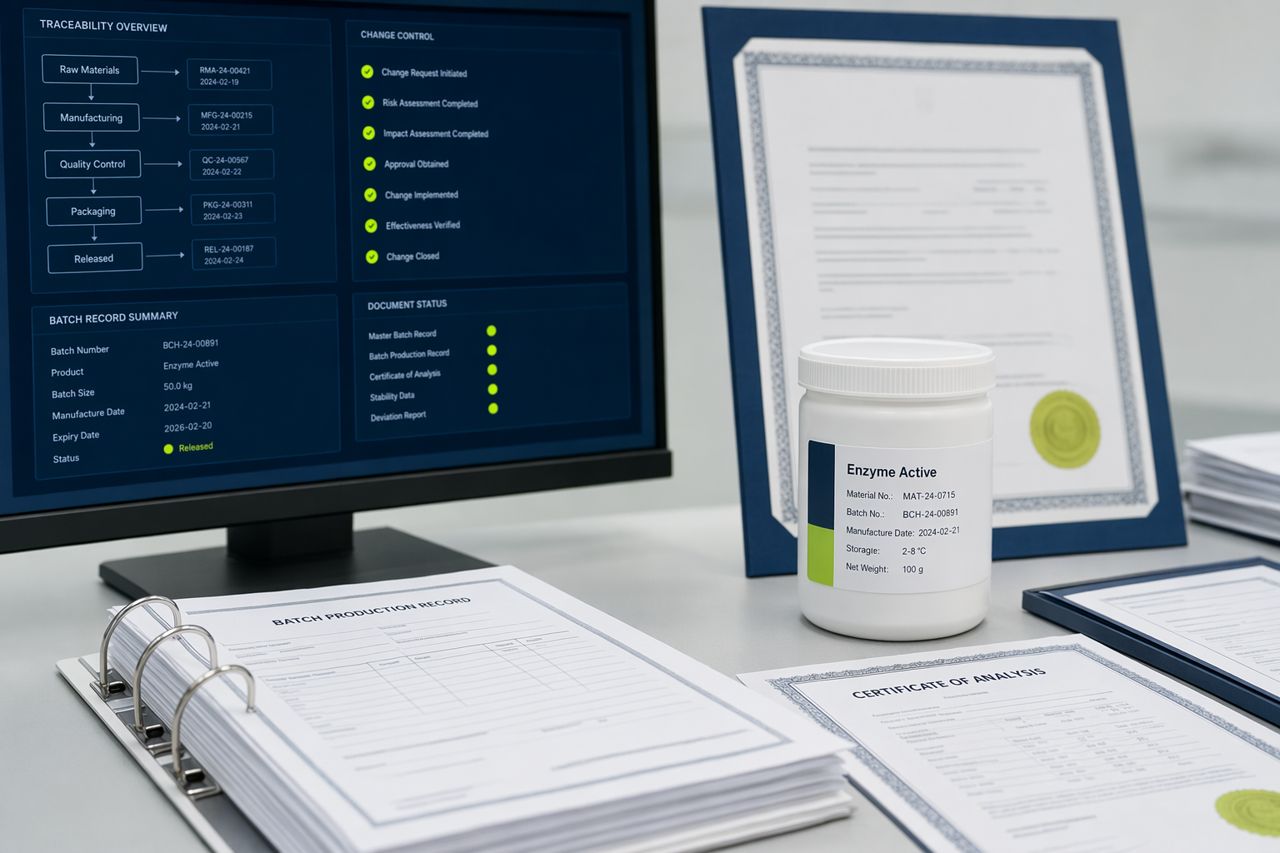
Documentation gaps can slow vendor qualification even when the enzyme performs well. For pharmaceutical API manufacturers, the sourcing package should be reviewed early with process, quality, and regulatory stakeholders.
A documentation-ready supplier helps reduce qualification friction and gives internal teams the information needed to assess risk before the route is committed.
The best enzyme for a reaction may still need the right physical format and handling profile for the manufacturing site. Discuss how the enzyme will enter the plant, how it will be charged, and how it will be removed or managed downstream.
Format alignment reduces plant adaptation work and helps process chemists design an enzyme step that is practical for GMP-adjacent or GMP manufacturing environments.
A qualified enzyme supplier should contribute technical judgment without overstating certainty. For API route development, support should be practical, data-oriented, and aligned with process decisions.
Strong technical support shortens the path from enzyme hit to manufacturable step and reduces the burden on internal teams when timelines are compressed.
For pharmaceutical API manufacturers, the lowest quoted enzyme cost is rarely the full process cost. A better comparison includes route risk, impurity burden, documentation readiness, supply reliability, and support quality.
| Criterion | What to confirm | Why it matters |
|---|---|---|
| Route fit | Conditions, selectivity, downstream compatibility | Reduces late process redesign |
| Impurity control | Side-product and carryover discussion | Supports analytical and regulatory strategy |
| Supply continuity | Bulk path, lead time, change control | Protects campaign planning |
| Documentation | Quality, traceability, origin, safety information | Supports vendor qualification |
| Technical support | Screening, troubleshooting, scale-up input | Accelerates development decisions |
| Plant readiness | Format, handling, storage, cleaning considerations | Improves manufacturing practicality |
A precise RFQ helps Chiralift evaluate enzyme fit and respond with a relevant sourcing path.
If confidentiality is required before technical disclosure, indicate that in the request.
Embed the faceless explainer video here with voiceover, subtitles, and clean industrial still-frame motion. The video should reinforce that enzyme sourcing is a route-quality decision involving impurity control, supply confidence, documentation, and scale-up support.
Chiralift is a bulk enzyme supplier for pharmaceutical biocatalysis focused on practical route implementation. We support process chemists and sourcing teams evaluating enzymes for chiral transformations, selective conversions, and manufacturing-relevant biocatalytic steps.
We keep the sourcing process technical, concise, and validation-aware.
If you are qualifying an enzyme for an API process step, send the route requirements, scale expectations, documentation needs, and target timeline through the on-site form.

Tell us your application and volume — we reply with pricing and lead time.